Papua New Guinea · Three Charts · 2026

All of PNG’s Prime Ministers Were Born Before Independence

Eight people have served as Prime Minister since Independence on 16 September 1975. None was born after that date. The three charts below set out their age at first appointment, that age against the median age of the population, and the 12 terms in office from 1975 to 2026.
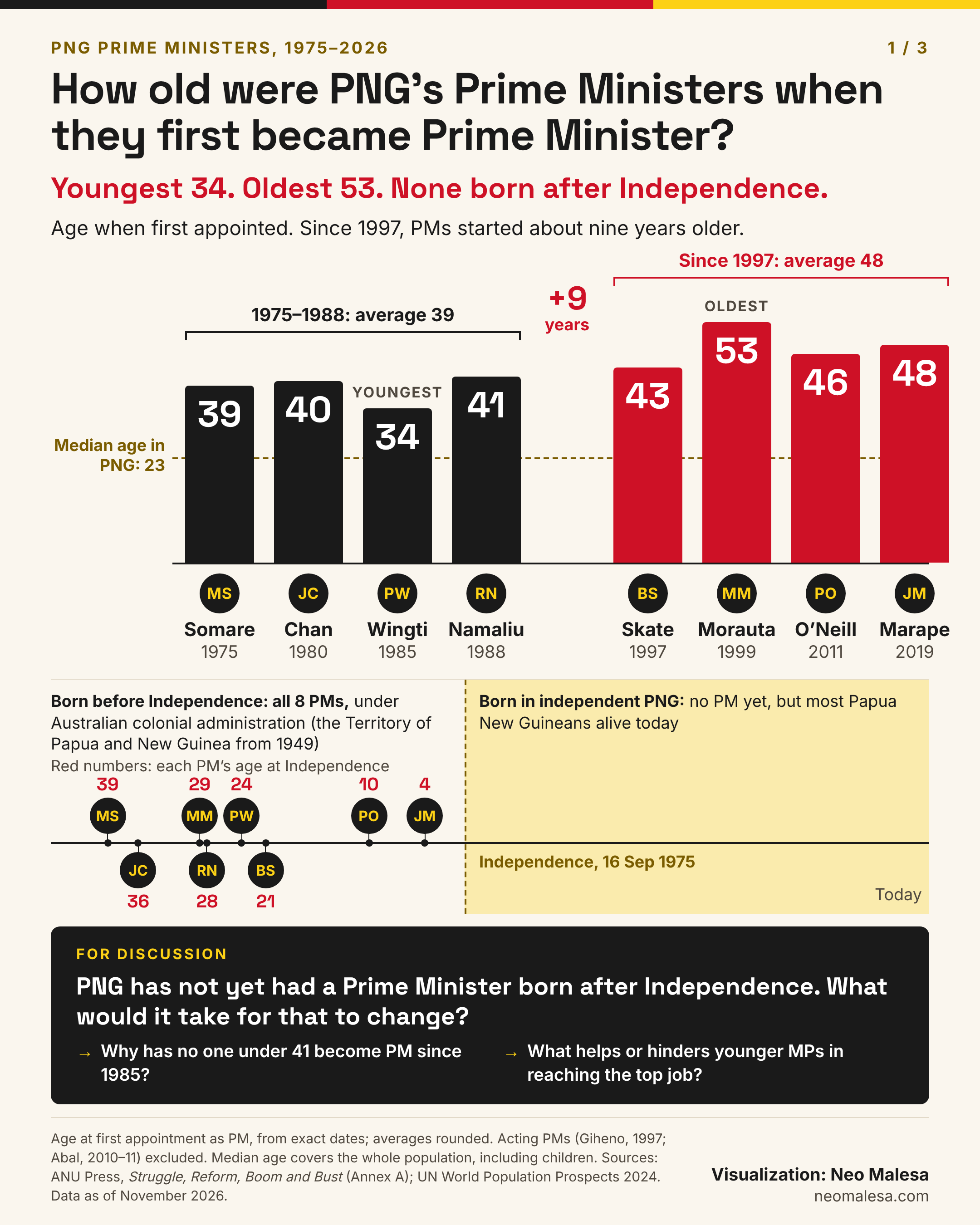
Bar chart: how old PNG’s Prime Ministers were when they first became Prime Minister. Youngest 34, oldest 53, none born after Independence. The first four averaged 39: Sir Michael Somare 39 (1975), Sir Julius Chan 40 (1980), Paias Wingti 34 (1985), Sir Rabbie Namaliu 41 (1988). Those appointed since 1997 averaged 48, about nine years older: Sir Bill Skate 43 (1997), Sir Mekere Morauta 53 (1999), Peter O’Neill 46 (2011), James Marape 48 (2019). A dashed line marks the national median age of 23. A strip below shows that all eight were born before Independence on 16 September 1975, under Australian colonial administration (the Territory of Papua and New Guinea from 1949). Their ages at Independence: Somare 39, Chan 36, Morauta 29, Namaliu 28, Wingti 24, Skate 21, O’Neill 10, Marape 4. Most Papua New Guineans alive today were born after Independence. For discussion: PNG has not yet had a Prime Minister born after Independence. What would it take for that to change?
1 of 3 Age at first appointment Download PNG
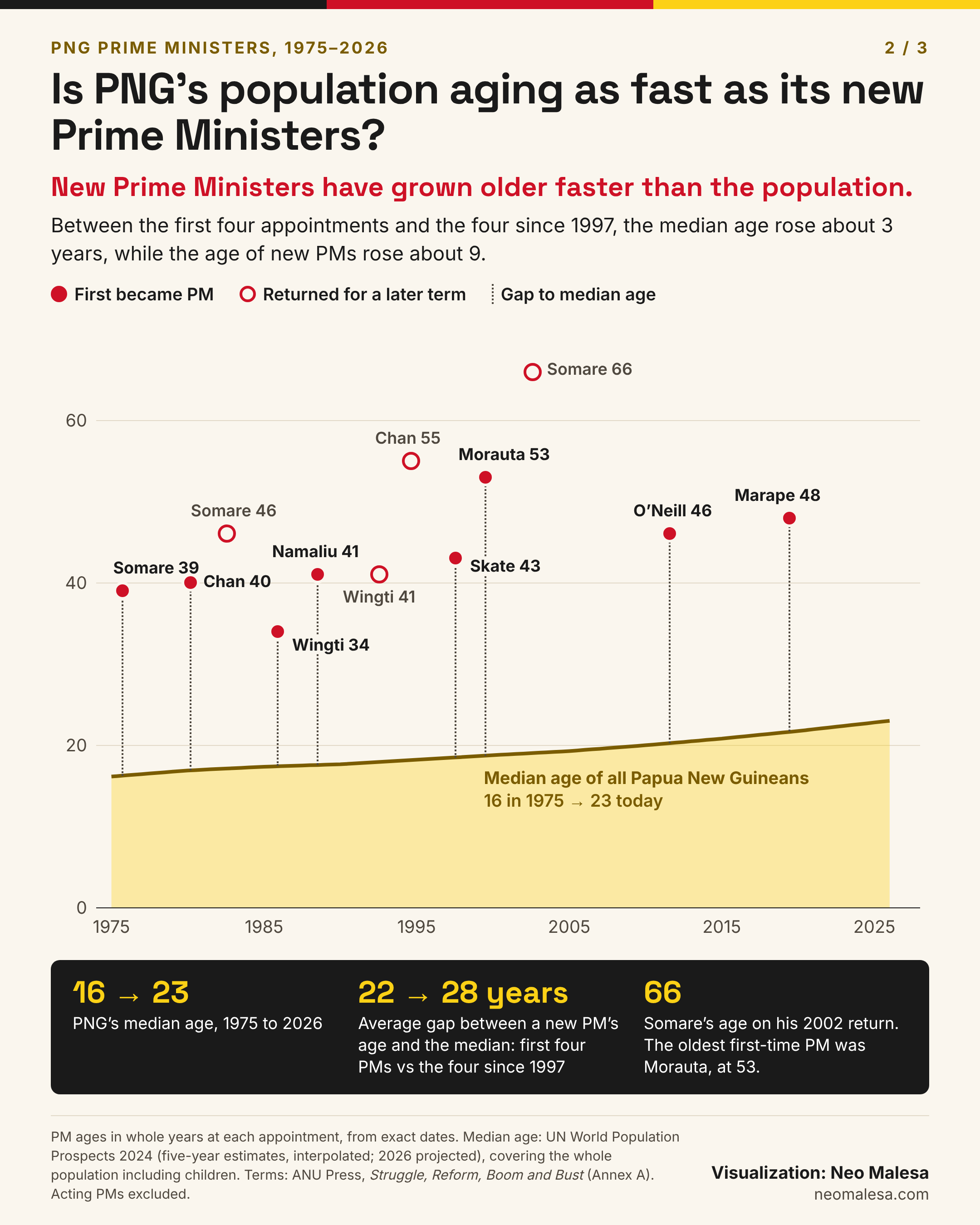
Chart: the age of each PNG Prime Minister at each appointment, plotted against the median age of all Papua New Guineans, 1975 to 2026. New Prime Ministers have grown older faster than the population. The median age rose from 16 in 1975 to 23 today. First appointments: Somare 39, Chan 40, Wingti 34, Namaliu 41, Skate 43, Morauta 53, O’Neill 46, Marape 48. Returns for later terms: Somare 46 and 66, Wingti 41, Chan 55. Between the first four appointments and the four since 1997, the median age rose about three years, while the age of new Prime Ministers rose about nine. The average gap between a new Prime Minister’s age and the median widened from 22 to 28 years. Somare was 66 on his 2002 return; the oldest first-time Prime Minister was Morauta, at 53.
2 of 3 Age against the median age of the population Download PNG
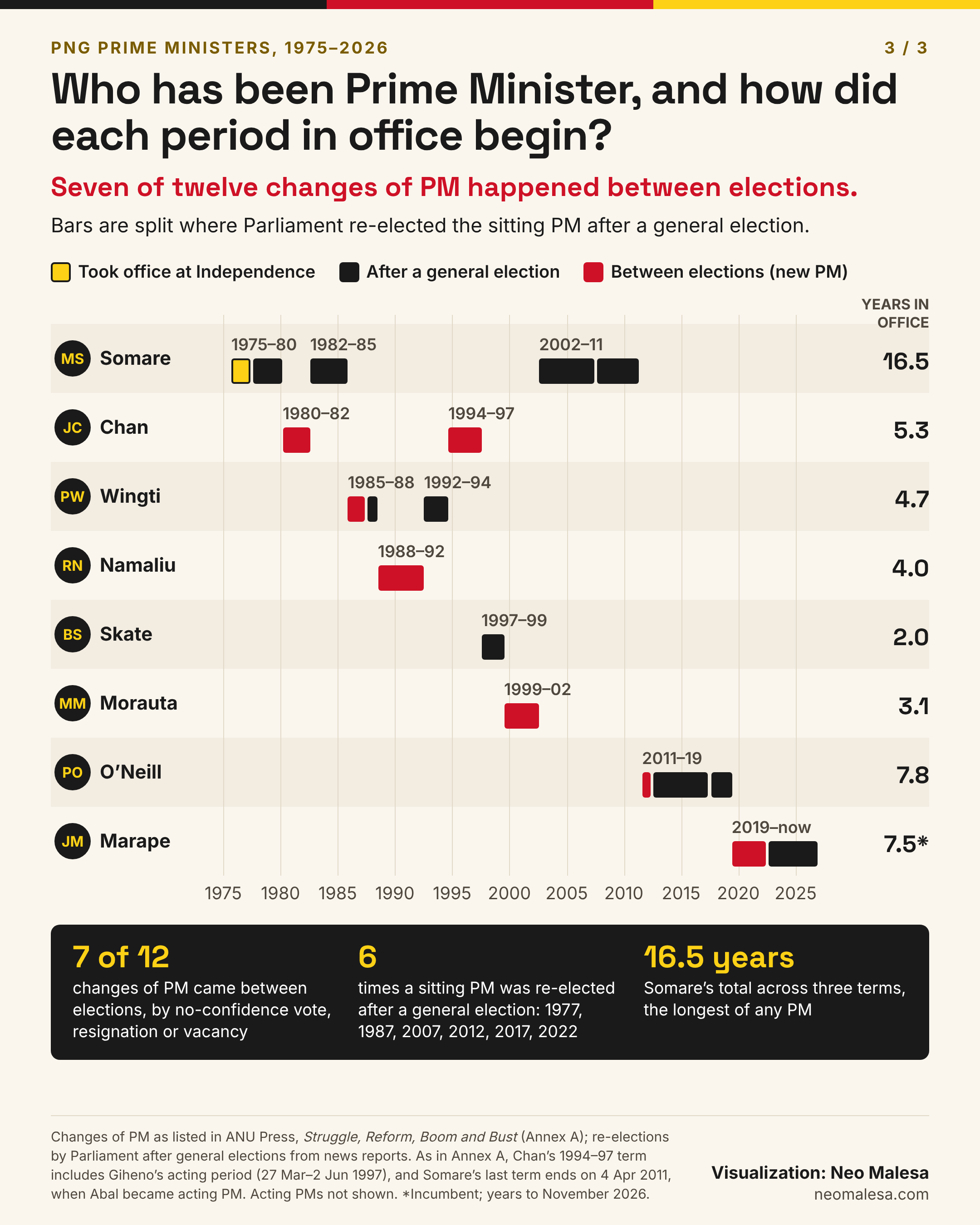
Timeline: who has been Prime Minister from 1975 to 2026, and how each period in office began. Bars are split where Parliament re-elected the sitting Prime Minister after a general election. Seven of 12 changes of Prime Minister came between elections, by no-confidence vote, resignation or vacancy. Sitting Prime Ministers were re-elected after general elections six times: 1977, 1987, 2007, 2012, 2017 and 2022. Somare: 1975–80, taking office at Independence and re-elected in 1977; 1982–85, after a general election; 2002–11, after a general election and re-elected in 2007; 16.5 years in total, the longest of any Prime Minister. Chan: 1980–82 and 1994–97, both between elections; 5.3 years. Wingti: 1985–88, between elections and re-elected in 1987; 1992–94, after a general election; 4.7 years. Namaliu: 1988–92, between elections; 4.0 years. Skate: 1997–99, after a general election; 2.0 years. Morauta: 1999–2002, between elections; 3.1 years. O’Neill: 2011–19, between elections, re-elected in 2012 and 2017; 7.8 years. Marape: 2019 to now, between elections, re-elected in 2022; 7.5 years to November 2026.
3 of 3 Who held office, 1975–2026 Download PNG

Sources

  1. Struggle, Reform, Boom and Bust: An Economic History of Papua New Guinea since Independence, ANU Press, Annex A. Prime Ministers and terms in office, 1975 onwards.
  2. World Population Prospects 2024, United Nations. Median age of the population: 16 in 1975, 23 in 2026 (projected).
  3. News reports of Prime Ministers re-elected by Parliament after general elections, for example “Papua New Guinea’s new parliament returns Marape as PM”, Al Jazeera, 9 August 2022.

Ages are calculated from exact dates of birth and appointment; averages are rounded. Acting Prime Ministers (John Giheno, 1997; Sam Abal, 2010–11) are excluded. The median age covers the whole population, including children. Data as of November 2026.